When you’re looking to boost your car’s audio setup, choosing the right subwoofer can really make a huge difference in how your music sounds. As industry pro Jason Lee, a well-known engineer and huge audio buff, says, “The right subwoofer can turn your car into a concert hall on wheels.” With so many options out there, picking the best subwoofer for your car isn’t exactly a walk in the park…and it’s all about paying attention to a few key things—size, type, power capacity, and design, to name a few.
In this little guide, I’ve rounded up the top 10 tips to help you find the perfect subwoofer for your car’s sound system. Whether you’re just in it for casual listening or you’re an audiophile craving that crystal-clear, deep bass, knowing what features and specs to look for can seriously level up your sound game. It’s also important to think about your vehicle’s space, what kind of power you need, and how you like your music—every little detail counts when you’re aiming for that rich, immersive sound.
By tapping into the expertise of audio pros and considering some practical advice, you’ll be able to pick a subwoofer that fits your vibe and your ride perfectly—making your favorite tunes come alive like never before.
Understanding the Importance of a Subwoofer in Car Audio Systems
A subwoofer is a crucial component of a car audio system, serving to enhance the overall sound experience by reproducing low-frequency sounds and bass. According to a study by the Consumer Technology Association, a rich bass response can significantly improve listener satisfaction, with up to 70% of car audio enthusiasts noting that they prefer systems with dedicated subwoofers. This highlights the importance of investing in the right subwoofer to achieve an immersive auditory experience while driving.
When choosing a subwoofer, it's vital to consider the size and type that best fits your vehicle's acoustics. For smaller vehicles, a compact subwoofer may provide sufficient bass without taking up too much space. Conversely, larger vehicles may benefit from more powerful subwoofers to fill the cabin with sound. Additionally, pay attention to power handling and sensitivity ratings; subwoofers with higher sensitivity can produce more sound at lower power levels, making your audio system more efficient.
Tip 1: Assess your available space before selecting a subwoofer; knowing the dimensions of your vehicle will guide you in choosing a model that fits seamlessly.
Tip 2: Ensure you consider the enclosure type, as the right enclosure can dramatically affect performance. Sealed enclosures typically deliver tighter, more accurate bass, while ported enclosures can produce louder and deeper bass.
By understanding the importance and functionality of subwoofers, you can elevate your car audio system significantly and tailor it to meet your listening preferences.
Key Specifications to Consider When Choosing a Subwoofer
When choosing a subwoofer for your car audio system, understanding key specifications is crucial for optimal performance. Firstly, consider the subwoofer size, typically ranging from 8 to 15 inches. Larger subwoofers may produce deeper bass, but smaller ones can offer better speed and control. According to industry reports, having a subwoofer with a diameter of at least 10 inches often provides a balance between power and clarity, making it suitable for most car audio enthusiasts.
Power handling is another vital specification, which indicates how much power (measured in watts) a subwoofer can handle without distortion. Look for a subwoofer with adequate RMS (Root Mean Square) ratings to ensure it can handle your amplifier's output. Research suggests that matching the RMS rating of the subwoofer with the amplifier's output is essential to prevent damage and achieve the best sound quality.
Tip: When selecting your subwoofer, consider the enclosure type. A properly designed enclosure can significantly enhance performance. Sealed enclosures optimize sound quality, while ported enclosures tend to produce louder bass at the expense of some sound clarity. Always choose an enclosure that complements your listening preferences and vehicle acoustics for the best results.
Different Types of Subwoofers: Which One is Right for You?
When selecting a subwoofer for your car audio system, understanding the different types available can greatly influence your listening experience. Generally, subwoofers fall into two main categories: sealed and ported. Sealed subwoofers provide tight, accurate bass and are less prone to distortion, making them ideal for genres that require precise audio reproduction. According to industry reports, sealed designs typically yield a flatter frequency response, making them a favorite among audiophiles. In contrast, ported subwoofers enhance the output at low frequencies by incorporating a vent or port, allowing for louder bass, which is particularly appealing for bass-heavy music enthusiasts.
When choosing the right type of subwoofer, consider the size of your vehicle and your audio preferences. For smaller cars, a compact sealed subwoofer can deliver powerful sound without sacrificing space. On the other hand, if you often transport larger groups or simply crave an earth-shaking bass experience, a ported subwoofer may be more suited to achieving that robust sound.
Tip: Always pay attention to the power rating of the subwoofer, as higher wattage often translates into better performance. Additionally, consider the enclosure type, as the right housing can significantly impact sound quality. Investing time in understanding these factors can help you select the ideal subwoofer, ensuring you enjoy the full potential of your car audio system.
Top 10 Tips for Choosing the Best Subwoofer for Your Car Audio System
| Subwoofer Type | Ideal Use Case | Power Handling (W RMS) | Size (Inches) | Price Range ($) |
| Component Subwoofer | High-performance custom builds | 300 - 1500 | 8 - 15 | 100 - 500 |
| Enclosed Subwoofer | Easy installation setup | 200 - 1000 | 10 - 12 | 150 - 600 |
| Sealed Subwoofer | Tight bass and smaller space | 200 - 1200 | 8 - 12 | 80 - 400 |
| Ported Subwoofer | Deep bass and high output | 300 - 1800 | 10 - 15 | 120 - 500 |
| Active Subwoofer | Convenient built-in amplifier | 200 - 800 | 8 - 12 | 100 - 400 |
| Carpeted SubWoofer Box
| Protection and aesthetics | N/A | N/A | 50 - 200 |
| Under-Seat Subwoofer | Space-saving installation | 100 - 400 | 8 - 10 | 80 - 300 |
| Wireless Subwoofer | No cables for sleek appearance | 150 - 600 | 10 - 12 | 120 - 500 |
| Shallow Mount Subwoofer | Limited space vehicles | 200 - 700 | 8 - 10 | 80 - 350 |
Matching Subwoofer Size with Your Vehicle for Optimal Performance
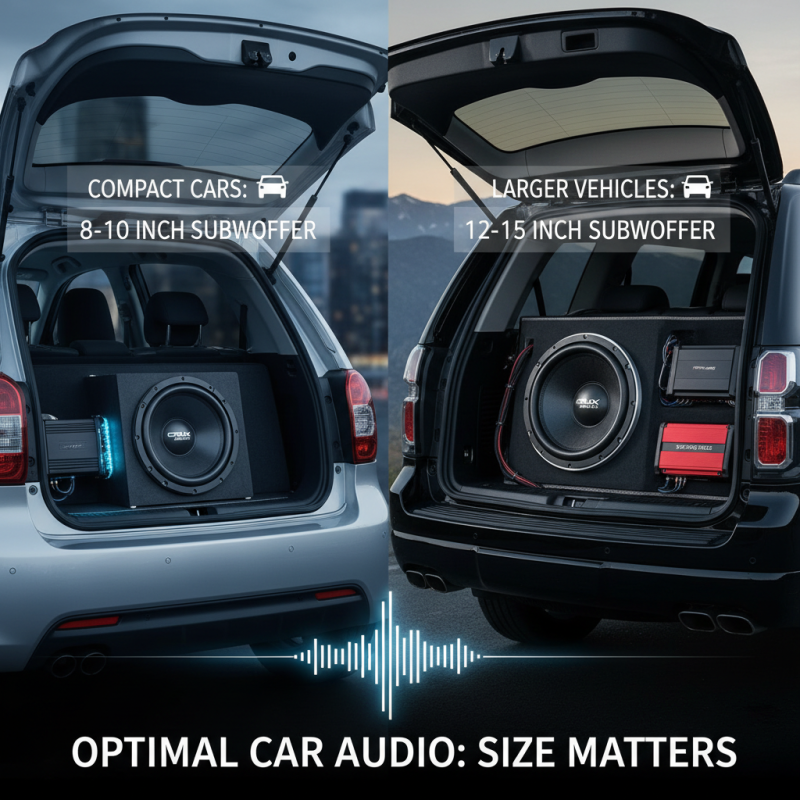
When it comes to enhancing your car audio system, selecting the right subwoofer is crucial forachieving optimal performance. One important factor in this equation is matching the subwoofer size with your vehicle. According to industry reports, subwoofers generally range from 8 to 15 inches in diameter, with different sizes suited to varying types of vehicles. For compact cars, an 8 or 10-Inch Subwoofer often provides an adequate bass experience without overwhelming the existing audio system. Conversely, larger vehicles like SUVs or trucks can benefit from 12-inch or even 15-inch subwoofers, delivering richer, deeper bass that complements their spacious interiors.
Additionally, understanding the vehicle's acoustics plays a pivotal role in the selection process. Research indicates that larger vehicles tend to possess more space, which can enhance low-frequency sounds emitted by bigger subwoofers. A 2018 study highlighted that SUVs equipped with 12 to 15-inch subwoofers experienced a 20% increase in sound pressure levels compared to those with smaller subs, resulting in a more immersive listening experience. Therefore, when choosing a subwoofer for your car, it's essential to consider not only the size of your vehicle but also how these dimensions interact with audio performance, effectively transforming your car into a sound haven.
Power Handling: Determining RMS and Peak Power Requirements
When selecting a subwoofer for your car audio system, understanding power handling is crucial. Power handling refers to the amount of power a subwoofer can handle safely, which is expressed in terms of RMS (Root Mean Square) and peak power. RMS indicates the continuous power the subwoofer can handle without distortion, while peak power denotes the maximum power it can withstand for short bursts. Aiming for a subwoofer with an RMS rating that comfortably exceeds your amplifier's output ensures optimal performance without risking damage.
When assessing your power requirements, consider the size of your vehicle and the types of music you enjoy. Larger vehicles might necessitate a subwoofer with a higher RMS rating to fill the cabin with sound effectively. It’s also important to match the subwoofer specifications with your amplifier to ensure both components work harmoniously. An underPowered Subwoofer can lead to distortion, while an overpowered one may get damaged quickly.
Tip: Always refer to the manufacturer's specifications for both your amplifier and subwoofer to find the right match. Additionally, consider testing out different configurations, such as using dual subwoofers, to enhance sound depth without exceeding power limits. Another tip is to prioritize subwoofers with built-in thermal protection, as this feature guards against overheating during powerful playback, ensuring longevity and reliability in performance.
Power Handling: RMS vs Peak Power Requirements in Car Subwoofers
Enclosure Types: Sealed vs. Ported Subwoofer Boxes
When selecting a subwoofer for your car audio system, the type of enclosure plays a crucial role in determining sound quality and performance. There are primarily two types of enclosures: sealed and ported. A sealed enclosure, which is airtight, offers tighter bass response and better sound clarity, making it an excellent choice for listeners who prioritize accuracy over sheer volume. This design reduces the chance of distortion, providing a more controlled and balanced audio experience, thus appealing to audiophiles who enjoy genres that require precision in sound reproduction.
On the other hand, ported enclosures are designed with a vent or port that allows air to escape from the box. This configuration enhances the efficiency of the subwoofers, delivering a deeper bass extension and increased output levels. While they can produce louder sounds, ported enclosures may sacrifice some sound accuracy compared to sealed designs. Therefore, they are often favored by those who enjoy bass-heavy music genres such as hip-hop or electronic dance music. Choosing between sealed and ported enclosures ultimately depends on your listening preferences and the type of sound experience you wish to achieve in your car audio system.
Budgeting for Quality: How Much Should You Spend on a Subwoofer?
When considering how much to spend on a subwoofer for your car audio system, it's essential to strike a balance between your budget and the quality you desire. Generally, a decent subwoofer can range anywhere from $100 to $500, but there are high-end models that may go even higher. It's important to assess what you aim to achieve with your audio experience. If you are an audiophile looking for rich sound and deep bass, investing a bit more can greatly enhance your listening pleasure.
In addition to the subwoofer itself, consider other related costs, such as amplifiers, installation, and wiring. Quality components improve the overall performance of your car audio system, so it’s wise to allocate funds not just for the subwoofer but for these additional elements as well.
Stick to your budget while ensuring you are not compromising on essential features. Setting your budget effectively will ensure that your investment leads to satisfying results without breaking the bank. This approach allows you to enjoy impressive sound quality and longevity from your audio system without unnecessary financial stress.
The Ultimate Sound Experience: A Deep Dive into the Invisible Seat Ultra-thin Subwoofer YL-1015C
The invisible seat ultra-thin subwoofer YL-1015C offers a revolutionary solution for audiophiles seeking to maximize their vehicle’s sound experience without compromising on space. This innovative subwoofer harnesses the power of an ultra-thin aluminum alloy design, enabling it to fit seamlessly under your car seat. With a frequency range of 20Hz to 150Hz, it delivers powerful bass that significantly enhances the audio performance of any standard car audio system. Offering a peak power of 800W and a rated power of 150W, the YL-1015C stands out in its category by providing a staggering bass boost capability ranging from 0 to +12dB.
Moreover, its impressive total harmonic distortion of less than 0.15% ensures a clear and undistorted sound, making it an excellent option for individuals who prioritize audio fidelity. The subwoofer's signal-to-noise ratio (SNR) exceeds 90dB, indicating an exceptional sound clarity that rivals that found in professional audio systems. This subwoofer is designed to work harmoniously with any car audio setup, whether it’s paired with a CD player or a navigation system. With a sensitivity rating of 91dB and resistance of 4Ω, the YL-1015C is engineered not only for performance but also for reliability, making it an outstanding choice for those looking to upgrade their in-car listening experience.
FAQS
: Subwoofers typically range from 8 to 15 inches. For compact cars, an 8 or 10-inch subwoofer is recommended, while larger vehicles like SUVs or trucks can benefit from 12 to 15-inch subwoofers for deeper bass.
Larger subwoofers can produce deeper bass and may enhance the overall listening experience, especially in bigger vehicles. However, smaller subwoofers tend to offer better speed and control, making them suitable for certain audio preferences.
Power handling indicates how much power a subwoofer can handle without distortion. Understanding it is essential to prevent damage to the subwoofer and ensure it performs optimally with your amplifier.
RMS (Root Mean Square) refers to the continuous power a subwoofer can handle without distortion, while peak power indicates the maximum power it can handle for short bursts. Ideally, choose a subwoofer with an RMS rating that exceeds your amplifier's output.
Matching the subwoofer's specifications with your amplifier ensures optimal performance and prevents distortion or damage. An underpowered subwoofer can distort sound, while an overpowered one might get damaged easily.
Enclosure type significantly impacts sound quality; sealed enclosures optimize sound clarity, while ported enclosures produce louder bass but may sacrifice some clarity. Choosing the right enclosure is essential for achieving desired audio results.
Larger vehicles typically enhance low-frequency sounds due to their size. It’s important to consider both the size of your vehicle and how it interacts with the subwoofer to create the best listening experience.
Look for subwoofers with built-in thermal protection to prevent overheating during high-volume playback. Testing different configurations, such as dual subwoofers, can also enhance sound depth without exceeding power limits.
Conclusion
Choosing the right subwoofer for your car audio system can significantly enhance your listening experience. Understanding the importance of a subwoofer is crucial, as it provides deep bass that standard speakers cannot deliver. Key specifications to consider include power handling, size, and the type of enclosure, such as sealed or ported boxes. Different types of subwoofers offer varied sound profiles, making it important to match the right type with your vehicle for optimal performance.
As you explore options, be mindful of your budget. Quality subwoofers are available at various price points, but investing in a reliable subwoofer for your car can make all the difference. By considering these factors, you can select a subwoofer that not only fits your vehicle and audio system but also delivers powerful, rich sound to elevate your driving experience.







 Email
 whatsapp